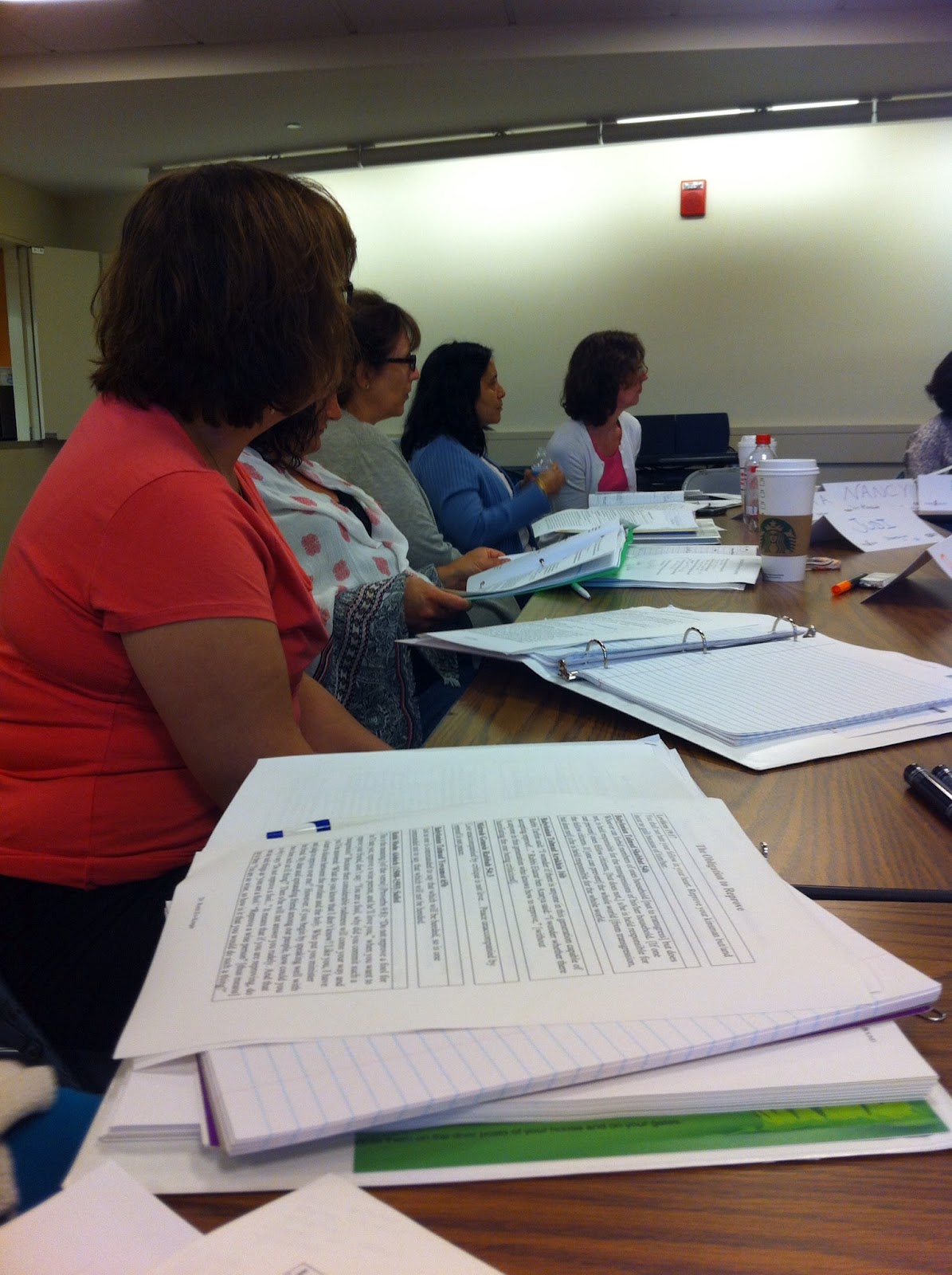
This fall, the teachers of the Children’s Center have been on a journey of learning in the course, “Teaching and Parenting Through a Jewish Lens.” Last week’s stop on our journey, allowed us to explore the concepts of chesed (love and kindness) and tzdaka (justice and charity). Ronit, our teacher, eloquently connected our current curriculum of bucket filling to chesed. In the story, “Have you Filled a Bucket Today?” it is written, “All day long everyone in the whole wide world walks around carrying an invisible bucket.” Ronit explained that what we fill these buckets with is in fact, chesed. Together we explored many texts and interpretations regarding chesed. One interpretation that particularly rung true of bucket filling was, “The challenge of activism is to ignite the divine spark present in the human spirit (Rabbi Avi Weiss, Spiritual Activism.” As a room of educators, we discussed this idea of doing chesed and igniting the divine spark in each child. In the Kohavim class, we are thinking a lot about how when you fill someone’s bucket your bucket is also filled. When you do chesed, it ignites this spark within you. The spark is in everybody, but it needs to be ignited. As educators, we are striving to understand each of your children and support them to ignite their own spark. As we left the wonderful day of teacher learning, many of us were inspired by the natural connection between bucket filling and Jewish values. We are eager to expand on our bucket filling curriculum by connecting it the chesed, as well as igniting the spark in each child.
Showing posts with label teacher learning. Show all posts
Monday, November 12, 2012
Wednesday, August 29, 2012
The Learning Has Begun
The teachers are back at school and the studying has begun!
Judaism’s culture of study and debate, literacy and life-long learning enables us to live more productive and meaningful Jewish lives. The entire faculty team meets regularly as a chavurah, a study group, to explore topics and issues of Jewish and communal curiosity and concern. The word chavurah comes from the Hebrew word chaver, meaning friend and is traditionally used to refer to a chavurah is a small group of study partners or friends.
How do we prepare an enriching and inspiring year for your child? By embarking on an enriching and inspiring study ourselves. We don't just do what we've always done. Instead, we reconsider our teaching practices, taking into account new developments and research in the field of early childhood education and we use that knowledge to continually enhance your child's experience.
I am proud to be part of a school that values lifelong learning and puts so much attention to modeling the value of learning for our children by surrounding them with adults who learn. Stay tuned as we share some of our learning experiences this week.
Judaism’s culture of study and debate, literacy and life-long learning enables us to live more productive and meaningful Jewish lives. The entire faculty team meets regularly as a chavurah, a study group, to explore topics and issues of Jewish and communal curiosity and concern. The word chavurah comes from the Hebrew word chaver, meaning friend and is traditionally used to refer to a chavurah is a small group of study partners or friends.
How do we prepare an enriching and inspiring year for your child? By embarking on an enriching and inspiring study ourselves. We don't just do what we've always done. Instead, we reconsider our teaching practices, taking into account new developments and research in the field of early childhood education and we use that knowledge to continually enhance your child's experience.
I am proud to be part of a school that values lifelong learning and puts so much attention to modeling the value of learning for our children by surrounding them with adults who learn. Stay tuned as we share some of our learning experiences this week.
Thursday, March 15, 2012
Teacher Learning!
Ellen invited Kris Scopinich from Drumlin Farm to our learning meeting last Monday. One of the many goals for the meeting was to improve the quality of outdoor education for the TBSCC. Kris explained that early learning standards are equally applicable to indoor and outdoor learning environments. However, most of the guidance provided for teachers about how to use them has focused on the indoors.
Kris gave us many ideas and took our learning session outside. Kris shared her plans/blueprint with us, to encourage outdoor learning both on the playground and in the wooded area beyond the TBS parking lot.
Ellen gave the entire staff a gift...A great book Lens on Outdoor Learning. Kris absolutely loves the book and uses it herself.
Today some of the Tel Aviv took the opportunity to make their "focusors". We cut out a whole in the middle of a paper plate and decorated it. The "focusors" are a tool to support outdoor learning experiences. When the children find something from nature they are curious about, they can place their "focusor" on it and take a closer look (an insect,rock, leaf). So simple, "Why didn't I think of that myself?" Thanks Kris! .
Sunday, February 12, 2012
Thinking with Found Materials
Yesterday, Sasha and I attended a workshop at the Eric Carle Museum. This workshop was developed to support learning for Pre-K through early elementary classroom and at home. In this workshop we collected and explored materials. These type of 'found~recycled~ materials support critical thinking skills when we offer children the opportunity to observe, interpret, evaluate, make associations, compare. In working in groups, as we often do, skills such as problem solving, cooperation are also learned.
Last week the Kohavim children created some beautiful works of art with 'recycled' materials and thought of some great 'stories' or narratives about are creations. Each came 'alive' in story form. We would like to continue this creative journey by requesting your help. If you could look in your drawers and around the house find some 'treasures' of recycled stuff. We would encourage you to think of color, texture, length, shape. Let your imagine run wild.
Some suggested materials to collect from the book I perused through are as follows:
Wire, feathers, beads and buttons, broken jewelry, tape, string, old keys, small machines that don't work, plastic socks, leather remnants, sponges, small seed pods, wood scraps, containers preferably white or transparent, baskets, cardboard pieces: all kinds of shapes and if possible with no writing or print, paper of different weights, textures and colors, screws and bolts, and small mirrors.
We would encourage you to involve the children in the selection process as well. When we put all the 'found' materials in a group pile, in the block room, we will create a storage space together, and begin our exploration journey and develop those critical thinking skills and expressive skills. Thank you for any help you could provide.
What you see in this picture is the city we created in small individual groups then developed a story line around our creations, similar to what your children did naturally last week. It was a wonderful workshop which was inspiring.
Monday, January 16, 2012
Attachment: I have an adult who cherishes me and keeps me safe.
This year your child's teachers have engaged in an intensive study of the critical life skills your child needs to thrive in today'd world. We've been working to understand the latest research, think about to help children develop in this area, and incorporate specific teaching of the skills into our daily curriculum. Together with the Children's Center Learning Committee we are studying the text Beyond Behavior Management by Jenna Bilmes. We invite you to join us in this study by purchasing your own copy to read at home. Come ask us about it!Over the past two months, our focus has been on learning about attachment, the skill of being able to depend on adults for safety and security, seeking out adults for conversation and play, and accepting comfort, love, and affection from a trusted adult. We have challenged our own long held notions about attachment and learned that many children who appear to have behavior issues may actually have weak attachment skills. Therefore, withholding attention as a punishment for this behavior can have the opposite of the intend effect on a child. Bilmes notes, "Making love and affection contingent upon 'good behavior' may seem to make sense on the surface. If children crave attachment to significant adults, wouldn't they behave better in order to get that love? In fact, the opposite is true. Children cooperate more with adults who accept them unconditionally. Early learning for children is relationship based."
Stay tuned for tips on how to support your child in developing strong attachment skills.
Labels:
attachment,
family activities,
life skills,
teacher learning
Thursday, December 22, 2011
To Israel!
On Sunday Tina will serve as part of a delegation of shagrirot (ambassadors) with 9 educators from our community to Israel for a week of learning, touring and visiting our partners in Haifa. Our partners put together a rich and meaningful program that will benefit the participants, their communities and the greater early childhood community. Upon her return Tina will share her experiences with our TBSCC community. This trip is part of the Boston/Haifa Early Childhood Connection and Tina has been preparing with study, joint learning, and classroom application over the past year. All through the school day you can see evidence of how important our connection to Israel is for all of us. The songs we sing, the Hebrew we speak, the pictures and books we look at, the topics we explore, all give us opportunities to bring Israel to us…and us to Israel. The same things have been happening in the classrooms in Haifa. As we celebrate Hanukkah in Needham the children in Haifa are singing the same songs, and spinning and making dreidels just like us.
Follow along with Tina's itinerary:
Sunday, December 25, Flight to Israel
Monday, December 26, Mt. Scopus overlooking the Old City to say the Shehechiyanu, Descend to the Kotel, Hanukah Candle-lighting
Tuesday, December 27, This Year in Jerusalem Begin the day at the Haas Promenade with a spectacular view over Jerusalem. Discussion on what “Lech Lecha” means in a modern context and whether Abraham passed the test of the Akeda. We then descend to the City of David, where Biblical Jerusalem began. Discussion of Jewish Political Morality in light of the Story of David and Bathsheeba. Walk through the dry Canaanite Tunnel and explore the recent excavations. Visit the Jewish Quarter & Cardo. Then we’ll explore the Machaneh Yehuda fruit & vegetable market and eat some sufganiot (doughnuts). Walk through Nahlaot neighborhood to see Hanukkiot displayed in homes.
Wednesday December 28, What Price Freedom? Ascend Herod’s mountain fortress of Masada by cable car. Delve into issues of the Great Revolt. Explore why the Jewish rebels chose to live here after the destruction of Jerusalem by the Romans. Descend by the cable car. Float in the Dead Sea. En route to Jerusalem, meet Ethiopian families who crossed the desert to Sudan to wait for months in refugee camps before being airlifted to Israel by the Mossad. Hannukah Candle-lighting with our Ethiopian hosts. Hands-on art program “Passover Haggadot” with Kol Ha’ot: Illuminating Jewish Learning Through Art.
Thursday, December 29, Jewish Space Workshop in the newly renovated Israel Museum. Set off for Tel Aviv. Reenact the moving moment when David Ben Gurion declared the establishment of the State of Israel at Independence Hall. Stroll through the Neve Tzedek neighborhood or the Namal (renovated port) area. Continue north along the Mediterranean Coast.
Friday, December 30, Visit partner early childhood schools in Haifa
Saturday, December 31, Shabbat with partner educators in Haifa
Sunday, January 1, School visits and secial program with Mirik Snir, Israeli children’s author, “literature as a second language.” At Hotel. Additional Haifa preschool educators are invited to join. Special program will include a talk, play, and materials exhibit
Monday, January 2, Yom Tiyul-Field trip with Israeli shagrirot to Ramat Ha-Nadiv near Zichron Yaakov. Special interactive workshop on the quality of the environment and promoting health. Walk through winery and main street in Zichron Yaakov.
Follow along with Tina's itinerary:
Sunday, December 25, Flight to Israel
Monday, December 26, Mt. Scopus overlooking the Old City to say the Shehechiyanu, Descend to the Kotel, Hanukah Candle-lighting
Tuesday, December 27, This Year in Jerusalem Begin the day at the Haas Promenade with a spectacular view over Jerusalem. Discussion on what “Lech Lecha” means in a modern context and whether Abraham passed the test of the Akeda. We then descend to the City of David, where Biblical Jerusalem began. Discussion of Jewish Political Morality in light of the Story of David and Bathsheeba. Walk through the dry Canaanite Tunnel and explore the recent excavations. Visit the Jewish Quarter & Cardo. Then we’ll explore the Machaneh Yehuda fruit & vegetable market and eat some sufganiot (doughnuts). Walk through Nahlaot neighborhood to see Hanukkiot displayed in homes.
Wednesday December 28, What Price Freedom? Ascend Herod’s mountain fortress of Masada by cable car. Delve into issues of the Great Revolt. Explore why the Jewish rebels chose to live here after the destruction of Jerusalem by the Romans. Descend by the cable car. Float in the Dead Sea. En route to Jerusalem, meet Ethiopian families who crossed the desert to Sudan to wait for months in refugee camps before being airlifted to Israel by the Mossad. Hannukah Candle-lighting with our Ethiopian hosts. Hands-on art program “Passover Haggadot” with Kol Ha’ot: Illuminating Jewish Learning Through Art.
Thursday, December 29, Jewish Space Workshop in the newly renovated Israel Museum. Set off for Tel Aviv. Reenact the moving moment when David Ben Gurion declared the establishment of the State of Israel at Independence Hall. Stroll through the Neve Tzedek neighborhood or the Namal (renovated port) area. Continue north along the Mediterranean Coast.
Friday, December 30, Visit partner early childhood schools in Haifa
Saturday, December 31, Shabbat with partner educators in Haifa
Sunday, January 1, School visits and secial program with Mirik Snir, Israeli children’s author, “literature as a second language.” At Hotel. Additional Haifa preschool educators are invited to join. Special program will include a talk, play, and materials exhibit
Monday, January 2, Yom Tiyul-Field trip with Israeli shagrirot to Ramat Ha-Nadiv near Zichron Yaakov. Special interactive workshop on the quality of the environment and promoting health. Walk through winery and main street in Zichron Yaakov.
Saturday, December 17, 2011
Hi from URJ Biennial!!


Hi everyone!
Allison, Ellen and I are here in Washington DC at the URJ Biennial convention. This convention is for anyone who is connected to the reform movement at large and is filled with Rabbi's, Cantors, educators, lay-leaders, students and dedicated high school students who are active in NFTY. There are around 5000 participants, 25 from TBS including two NFTY students. Here we have had the opportunity to participate in a variety of different learning sessions and prayer experiences. We have heard absolutely phenomenal speakers including author Wendy Mogel and President Obama. I highly encourage you to read Mogel; she uses wit and humor to discuss raising the next generations. I was particularly please when she said how important it is to send kids outside! Obama gave beautiful words of Torah and learning as he gave a very genuine and relatable speech about saying "Henani: Here I am" to the issues facing society today.
The union launched it's new campaign for youth engagement to help create more programing to keep our youth engaged in synagogue life from birth through high school. It is so neat to have the opportunity to learn about other innovative programs that temples around the country are doing, but the more I have learned the more I have realized how lucky I am to work at such a treasure as TBS.
There have been a few sessions targeted on early-childhood programs specifically. I participated in a session called , "how the economy is affecting pre-schools" that viewed early-childhood centers through a political and economic lens which is something I have little experience with. I also participated in a Tot-Shabbat song session and Yoga T'filah yesterday and am excited to bring more songs and stories and movement to the Tel Aviv class!
It has truly been an amazing weekend filled with rich learning and a vibrant community. However, Allison and I both miss our classes and will be thrilled to see everyone on Monday morning!!
Have a wonderful rest of your weekends and see you soon!
Labels:
Haifa,
professional development,
teacher learning,
Tel Aviv
Sunday, October 9, 2011
Self Regulation: An Introduction
Over the past two months, teachers have engaged in an intensive study of self regulation, understanding the latest research, thinking about to help children develop in this area, and incorporating specific teaching of the skills into our daily curriculum. We began by reading the text Beyond Behavior Management by Jenna Bilmes. We invite you to join us in this study. Look for a series of blog posts (marked by the brown life skills logo) on the topic, and come ask us about it.
"One of the most troubling challenges for [parents and] early childhood teachers is the child who lacks emotional self management skills. These children might hit before they think, can't wait for a turn, or cry and have tantrums easily. Teachers might observe that these kids seems to be controlled by their emotions, much as newborns are. When newborns are hungry, they cry. When they are colicky, they kick their legs and scream. When they sense a nipple, they root and latch on. No thought goes into this behavior. Newborns feels and then do. Children who lack emotional self management skills appear to behave in a similar way." Beyond Behavior Management by Jenna Bilmes, page 7.
So what can we do, both at home and at school, to help our children develop self regulation? Later this week, we'll introduce the building blocks of self regulation, and then we'll focus on specific strategies you can use at home.
"One of the most troubling challenges for [parents and] early childhood teachers is the child who lacks emotional self management skills. These children might hit before they think, can't wait for a turn, or cry and have tantrums easily. Teachers might observe that these kids seems to be controlled by their emotions, much as newborns are. When newborns are hungry, they cry. When they are colicky, they kick their legs and scream. When they sense a nipple, they root and latch on. No thought goes into this behavior. Newborns feels and then do. Children who lack emotional self management skills appear to behave in a similar way." Beyond Behavior Management by Jenna Bilmes, page 7.
So what can we do, both at home and at school, to help our children develop self regulation? Later this week, we'll introduce the building blocks of self regulation, and then we'll focus on specific strategies you can use at home.
Subscribe to:
Posts (Atom)