Showing posts with label life skills. Show all posts

Tuesday, October 15, 2013

Problem Solving

Problem solving and conflict resolution are some of the most important skills to learn in the early childhood years.  parents of alumni return later to tell us it is these skills that aided their child in elementary school years.  We strive to teach children that they can be problem solvers and resolve conflicts.  Problems and conflicts are a normal part of life, from young children through adults.  We aren't trying to teach children  to avoid these conflicts.  Instead we seek to teach them strategies to address them.

When a child graduates from preschool, we want them to be confident and competent problem solvers, with at least 5 strategies at the ready.  We want them to know which to use for any given situation, and we want them to use them skillfully.  Today we introduced the first strategy "Stand up for yourself"( Stop) and used role playing and a puppet (our dear friend Bruce) as a tool to support learning the strategy.  Moving forward we will have games, dramatic play, and all sorts of fun activities designed to help your child internalize each of the strategies.

We invite you to join us by using the same language and strategies at home.  The five problem solving strategies we will teach over the next several months  include...Stop! And stand up for yourself, Get Help, Walk Away, Ignore and Negotiate.

Today at our second morning meeting we asked the children if they had the opportunity to use the "Stand up for yourself"  strategy outside on the playground?  Sally shared that another child kicked her,and she told that child, "Stop, I don't like it when you kick me!"  Ellie shared, "I told someone in the sandbox "Stop not sharing the shovel."  Lily O came forward and found a shovel for Ellie to dig with.  Lily 's friendly behavior "filled"  Ellie's bucket!  Thanks Lily!

Next week we will introduce the "Get Help" Strategy! 

Saturday, November 10, 2012

We Are Problem Solvers!

On Friday Bruce the shark stopped by to help Lauri and Sasha introduce another problem solving strategy...WALK AWAY!

The children were asked to share their personal stories as to how they are using the problem solving strategies at home and at school. Josie, Adam and Elias talked about how they are having success while using the "STOP" strategy at home with their sibling.

The children are really starting to internalize the strategies. They are using the language and becoming confident and competent problem solvers!

Sunday, November 4, 2012

Hey he/she is dipping into my bucket... What CAN we DO?


One of the questions  asked at  curriculum night was: what about bucket dipping? For those unfamiliar with the book, bucket dipping is when our actions or words hurt someone's feelings. 

How do we as teachers respond to these situations? First we want to empower your children with the language to respond to these situations: Say, "STOP I don't like what you said or did" and get help from teachers as necessary.  Children are not innately bad . We need to provide them with opportunities to think and reflect upon how their words were hurtful, take the other person's perspective,  and think about what they can do to make things better. We model our speech and actions so everyone feels loved and respected. We will be working on developing those life skills of negotiating differences, saying STOP, ignoring and walking away when necessary, and getting help throughout the year.

Saturday, November 3, 2012

Belonging is Key

Children want to belong and understand how bad it feels not to belong. How many times have you heard one child say to another, "You're my friend, right?" And how many times when they are angry have you heard them say things like "You're not my friend" or "You can't come to my birthday?" Belonging, whether to a family, a synagogue, a club, or a classroom, helps children feel secure and guides then to learn social rules and expectations for behavior.

Think About It
Reflect back on your own connections with others at work or in your community. Perhaps you've served in the military or are active in the Jewish community or regularly gather wit extended family. What do these connections mean to you? How have these connections guided you in your life? Help the children i your life begin to understand their own connections to other, beginning with their own family.

Some Ideas
  • Help children build their identity as a member of your family. Put together a photo album that includes pictures of them as they are growing up as well as pictures of your immediate and extended family at all different ages. Share stories with your children about your own positive childhood memories.
  • Be clear with children about your family's values. When explaining rules and limits, think of saying, "In our family we (day please, don't eat meat, braid our hair)." When your child does something against family rules, say something like "Robinson children don't take things that don't belong to them."
  • Start family rituals such as eating spaghetti every Friday night or planting seeds on the first day of spring or reading books under a tree.
  • Help your child make friends by inviting another child along to join you at the park or join your family for supper.
Jenna Bilmes

From Beyond Behavior Management: The Six Life Skills Children Need, second edition by Jenna Bilmes, 2012. Published by Redleaf Press, www.redleafpress.org. Reproduced with permission. 

Problem Solving in the Tel Aviv Class


On Curriculum Night we spent time sharing a few of our many goals we have for the Tel Aviv children this year...

Our goal this year is for the children to graduate with at least 5 problem solving strategies at he ready.  We want them to be skilled at the difficult task of reading other peoples intentions, we want them to know which strategy to use for any given situation, and we want them to use them skillfully. Our ultimate goal is to have parents encourage these strategies and use them at home and at school.

Problem solving and conflict resolution are some of the most important skills to learn in the earl;y childhood years.  Parents of older children tell us it is these skills that aided their child in elementary school.  We strive to teach children that they can be problem solvers and resolve conflicts.  Problems and conflicts are a normal part of life, from young children through adults.  Most importantly we aren't trying to teach children to avoid these conflicts.  Instead we seek to teach them strategies to address them.

Here is how we teach teach the strategies in our classroom.  During our small group discussions we introduce the strategies to the children one at a time.  We separated the poster in to 5 individual ones, putting one picture up at a time.  Over the last several weeks, we have referred often to the pictures when discussing conflicts, along with the different possible strategies to use to resolve them.  We have used puppets and role playing to teach the strategies but we have been most successful coaching the children to use the strategies at the critical times that the conflicts were actually happening.

After a short meeting at the rug parents were invited to use glue,colored paper, jewels and markers to decorate wooden block.  They were asked to give the block a little personality!   On Friday morning  the children had the opportunity to decorate the other side of the block.  We will place the blocks in our Block Center.  We will encourage the children to play with the blocks and use them to  role play and act-out conflicts as they arise.


Thursday, February 2, 2012

Partner Planting!


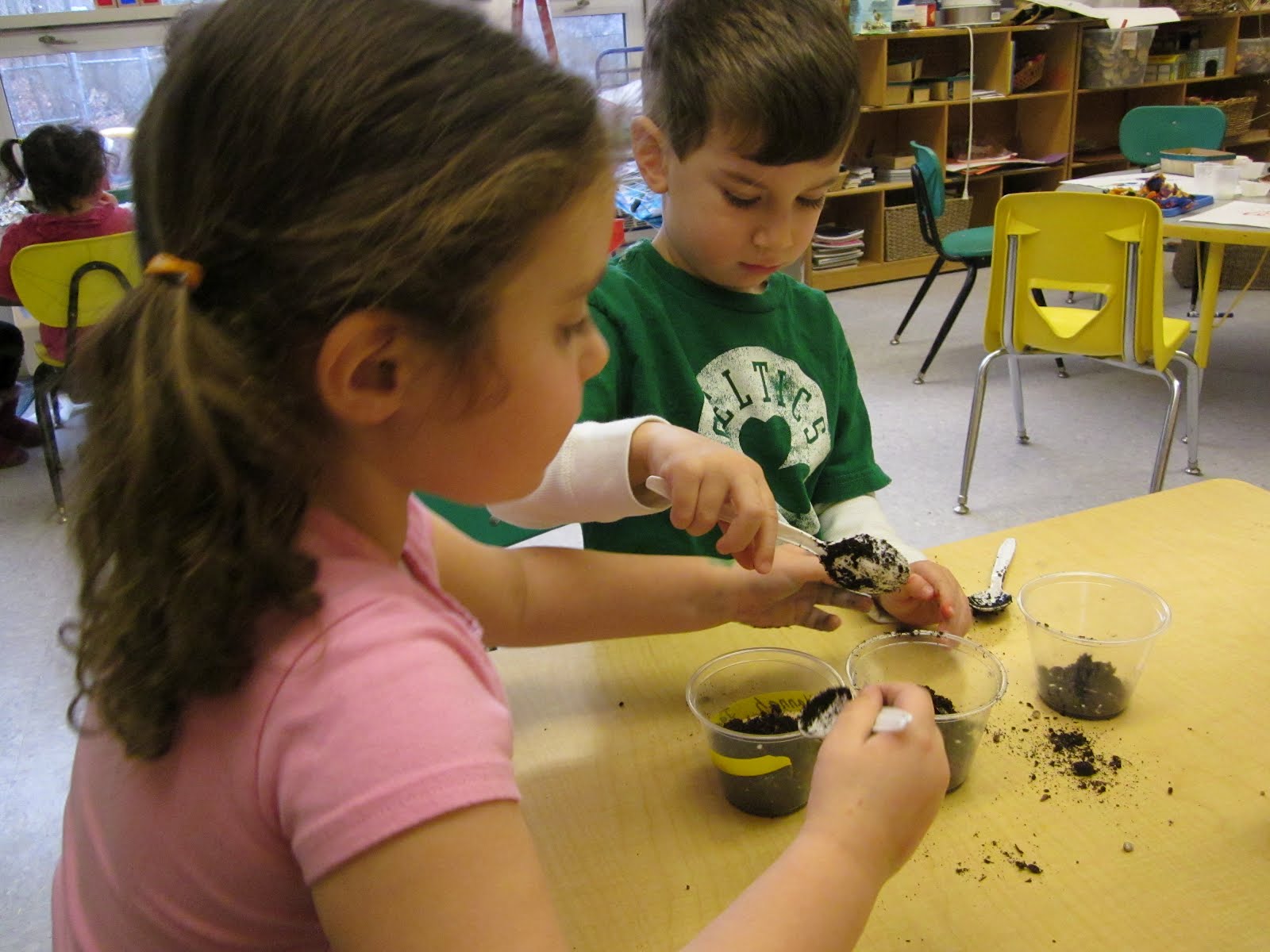
Today we asked the children to plant with a buddy. We called the children over two by two and asked them to plant flowers (Delphinium). One teacher stayed with the two children and coached/helped them work smoothly with each other. Each day they will care for their plant together.

Giving children plenty of opportunity for dyad play will prepare them for the more hectic and involved play with three to five children.

Monday, January 16, 2012

Attachment: I have an adult who cherishes me and keeps me safe.

This year your child's teachers have engaged in an intensive study of the critical life skills your child needs to thrive in today'd world.  We've been working to understand the latest research, think about to help children develop in this area, and incorporate specific teaching of the skills into our daily curriculum.  Together with the Children's Center Learning Committee we are studying the text Beyond Behavior Management by Jenna Bilmes.  We invite you to join us in this study by purchasing your own copy to read at home.  Come ask us about it!


Over the past two months, our focus has been on learning about attachment, the skill of being able to depend on adults for safety and security, seeking out adults for conversation and play, and accepting comfort, love, and affection from a trusted adult.  We have challenged our own long held notions about attachment and learned that many children who appear to have behavior issues may actually have weak attachment skills.  Therefore, withholding attention as a punishment for this behavior can have the opposite of the intend effect on a child.  Bilmes notes, "Making love and affection contingent upon 'good behavior' may seem to make sense on the surface.  If children crave attachment to significant adults, wouldn't they behave better in order to get that love?  In fact, the opposite is true.  Children cooperate more with adults who accept them unconditionally.  Early learning for children is relationship based."


Stay tuned for tips on how to support your child in developing strong attachment skills.

Wednesday, December 14, 2011

Games encourage group cooperation!


Today the Haifa and Tel Aviv children played Squirrels,Change Trees.
Here is how you play...

Set up more chairs than children, and have everybody choose one. Play music. Everyone runs, gallops, hops around the chairs (all of the children move in the same direction of the classroom). When the music stops the children (squirrels) find a seat(tree). Start again and take away one or two chairs until there are more children than chairs. The children are asked to help the children that don't have a chair (tree) to sit in, problem solve and make room for a fellow squirrel.

This organized game encourages group cooperation, problem solving, conflict resolution strategies, and team building. This is a game only preschooler would love!

Winter is coming!


Over the course of the last few weeks often we hear the Tel Aviv children say, "I'm cold I want to go inside!" The weather is definitely changing and as we all know the cold real cold weather, is yet to come.

Today Ezra was cold and he was wearing a warm jacket , a hat and mittens too. So I suggested we run around the playground to warm up. All I had to say was, "tag you're it," and the entire Tel Aviv group was running and running! Somehow I was the chaser and they were the runners, for most of the game in fact. Thank goodness they called the picnic table a (safe) base, so I could take a rest.

At circle time I suggested that the children wear layers underneath their coats because we will have outside time even in the very, very cold weather!

Monday, October 24, 2011

Self Regulation: Cause & Effect

It is easy to assume children understand the connection between their behavior and the result. In fact, most young children are just beginning to connect their actions with the consequences. Once they make this connection, they can begin to control their impulses, predict the results of their choices, and use that information to more deliberate decisions about what actions to take.

At school we reflect on children’s actions, calling their attention to cause and effect. You can use this simple sentence template at home: “You (action) and (result.)"
 

“You turned the crank and the clown popped up.”
“You mixed red and yellow and look what you got.”

Wednesday, October 19, 2011

Self Regulation: My Behavior Affects Others

In order to help children develop self-regulation skills, they must first understand that their behavior has an impact on the feelings of others. It is important not to encourage children to think they can control the feelings of others. At school we use the language below to help children understand that while feelings are reactions to events, no one can make someone else feel something.
 
Instead of using the word MAKE…
Try “When you ____, I feel _____.”
“Tell Raymond how he made you feel.”
“Tell Raymond that you don’t like it when he calls you names.”
“Don’t make me call your mother.”
“When I call and you don’t come in, I feel very frustrated.”
“Look at his face. How did you make him feel?”
“When you told Benjamin he couldn’t play, he felt bad.”

Adapted from Beyond Behavior Management: The Six Life Skills Children Need to Thrive in Today’s World by Jenna Bilmes.

Monday, October 17, 2011

Self-Regulation: Feelings are Responses


Most young children don’t know where their feelings come from. The first step in managing emotions is to understand where they are coming from. At school we help children understand that their feelings are responses to events outside themselves. Just as events and people affect each of us, we have an impact on the feelings of others. By weaving this language into every day conversation, we help children begin to make these important connections:


When…
Template…
Example…
Outside events have an impact on their feelings
You feel (emotion) because (event)
“You feel excited because Marge is coming for supper.” Or “You feel tired because you worked so hard on the climber.”
Other people’s actions have an impact on their feelings
When (person) (action), you felt (emotion).
“When Margaret said you couldn’t go to her birthday, you felt sad.” Or “David shared his blocks and you felt good.”
Their actions have an impact on other people’s feelings
When you (action), (other person) felt (feeling)
“When you pushed Denise, she felt angry.” Or “Jose liked it when you asked him to sit by you at circle.”


Adapted from Beyond Behavior Management: The Six Life Skills Children Need to Thrive in Today’s World by Jenna Bilmes.

Friday, October 14, 2011

What Does Self Regulation Look Like?

As we consider a child's developing self regulation skills, we are looking for the four building blocks:

1- Taking ownership for the consequences of our own actions.  Developing a sense of cause and effect and of how our behavior affects us, others, and our environment.

2- Understanding limits and expectations.  Learning some guiding principles of behavior and knowing there are some things that each of us is expected to do, whether we want to or not.

3- Learning to manage one's own powerful emotions.  Learning that although all feelings are ok, we must think before acting.

4- Figuring out time, space, and transitions and being able to move in a predictable way through the day.  Learning how to wait, how to share space, and how to deal with changes.

Adapted from Beyond Behavior Management by Jenna Bilmes

Sunday, October 9, 2011

Self Regulation: An Introduction

Over the past two months, teachers have engaged in an intensive study of self regulation, understanding the latest research, thinking about to help children develop in this area, and incorporating specific teaching of the skills into our daily curriculum.  We began by reading the text Beyond Behavior Management by Jenna Bilmes.  We invite you to join us in this study.  Look for a series of blog posts (marked by the brown life skills logo) on the topic, and come ask us about it.

"One of the most troubling challenges for [parents and] early childhood teachers is the child who lacks emotional self management skills.  These children might hit before they think, can't wait for a turn, or cry and have tantrums easily.  Teachers might observe that these kids seems to be controlled by their emotions, much as newborns are.  When newborns are hungry, they cry.  When they are colicky, they kick their legs and scream.  When they sense a nipple, they root and latch on.  No thought goes into this behavior.  Newborns feels and then do.  Children who lack emotional self management skills appear to behave in a similar way."  Beyond Behavior Management by Jenna Bilmes, page 7.

So what can we do, both at home and at school, to help our children develop self regulation?  Later this week, we'll introduce the building blocks of self regulation, and then we'll focus on specific strategies you can use at home.